Head of Faculty
Mrs H Seaward email
Members of Faculty
Science Curriculum Intent Statement
| Mrs R Bali | Teacher of Science | |
| Mrs J Chavda | Teacher of Science | |
| Ms S Clarkson | Teacher of Physics | |
| Miss Taneeka Edwards | Teacher of Science | |
| Miss K Ghumra | Teacher of Science | |
| Miss S Hazlehurst-Irving | Teacher of Science | |
| Mrs J Laidler | Teacher of Science/Vice Principal | |
| Ms Maryam Meetha | Teacher of Science | |
| Mr P Morbey | Teacher of Science/Head of Year 10 | |
| Miss M O’Gorman | Teacher of Science | |
| Miss J Patrick | Teacher of Science/Assistant Faculty Leader | |
| Mrs K West | Teacher of Physics | |
| Mrs A Yassin | Teacher of Science | |
| Mrs R Tughan | Senior Science Technician | |
| Miss P Campbell | Science Technician | |
KS3
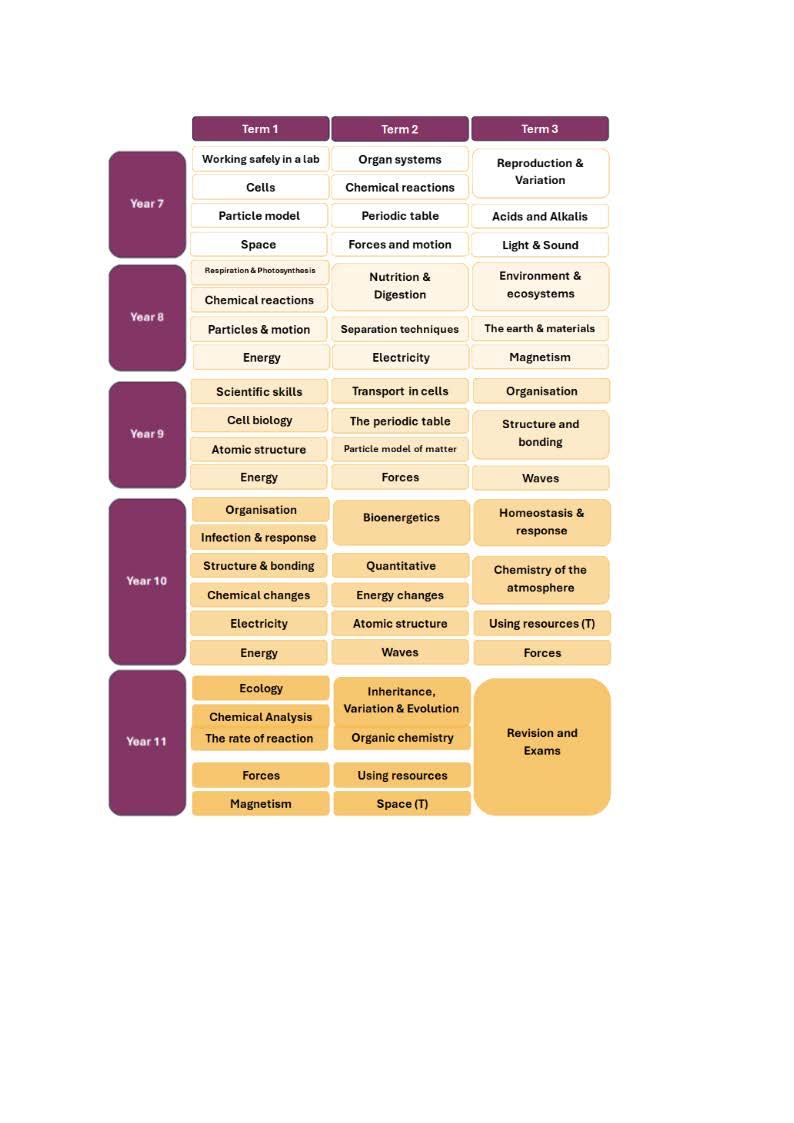
Our Science curriculum at Key stage 3 has been designed to provide students with a deep understanding of Scientific knowledge and ideas whilst developing and maintaining curiosity about the world, enjoyment of scientific activity and an awareness of how natural phenomena can be explained. These core ideas are revisited in growing complexity throughout the KS3 course to prepare our students for GCSE, but also to ensure a breadth in science knowledge and to allow students to explore and experience many fields of science.
Students learn about scientific enquiry through scientific skills lessons. Students learn about the development of Scientific thinking, Experimental skills and strategies, and Scientific language and quantities, inspiring a desire for students to explore the world around them and appreciate the value of science in their everyday lives.
KS4
The Science team work closely with students and their parents to ensure that every student is following the correct course at GCSE. Students can follow the AQA Combined science Trilogy, or AQA Separate science route at GCSE.
Exam Board: AQA https://www.aqa.org.uk/subjects/science
GCSE COMBINED SCIENCE TRILOGY
The combined science course comprises two GCSEs, which is assessed across six GCSE exam papers. Two papers in Biology, Chemistry and Physics, each 1hour 15min.
Students learn combined Science through a mixture of theory and practical lessons. The combined Science course has a substantial practical element, and students complete 21 required practical activities. The practical element is assessed across the exam papers.
GCSE SEPEARTE SCIENCES
The Separate science course comprises three GCSEs. Students following this course receive a GCSE grade in Biology, Chemistry and Physics. Each GCSE is assessed in two exam papers, each 1hour 45min.
Combined and separate science courses do cover the same units; however, the Separate science course does cover some units in more depth, with more mathematical content. Physics GCSE also has an extra unit, which covers Space.
The Separate science course is also taught through a mixture of theory and practical lessons and has a greater required practical element. Students complete 28 required practical activities. The practical element is assessed across each exam paper in the same way that it is for Combined Science.
KS5
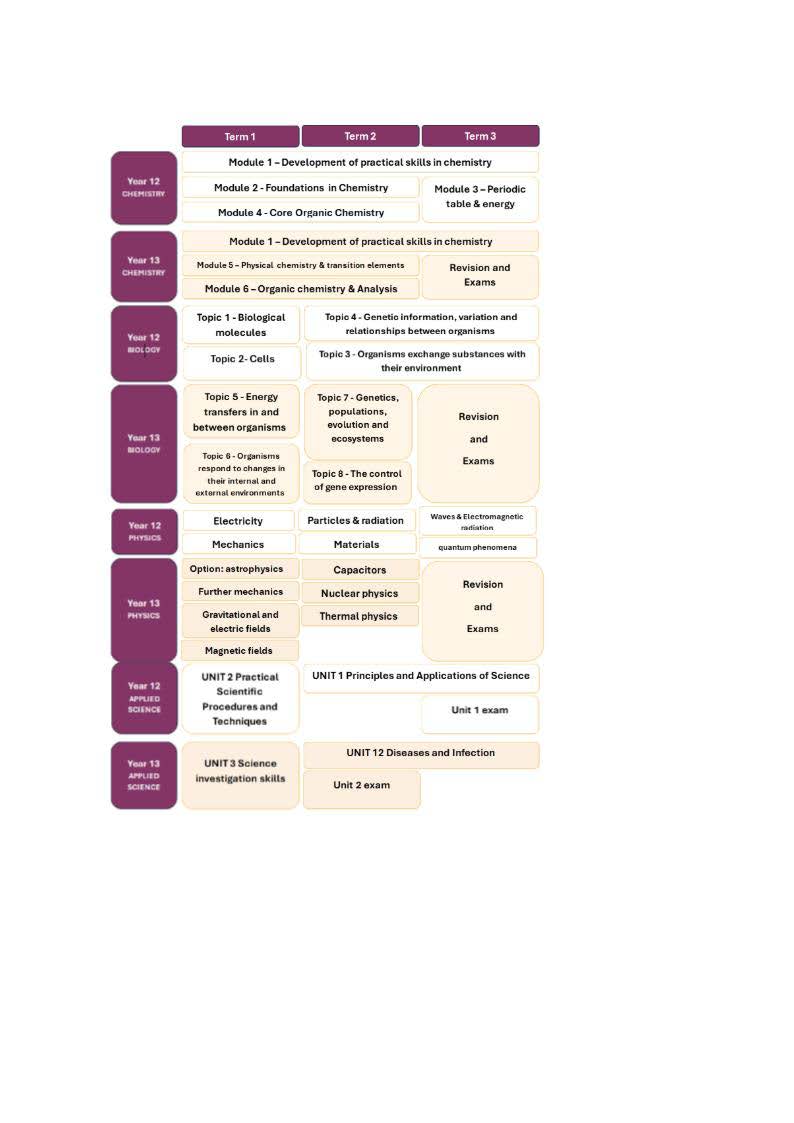
Studying Science at Key stage 5 offers a platform for future advanced science-based study or a gateway into a wide range of career opportunities. Studying A Level’s in Science is a wonderful opportunity to develop both important practical skills and scientific knowledge.
CHEMISTRY
Students follow the OCR A Specification.
Exam board: AS and A Level – Chemistry A – H032, H432 – OCR
BIOLOGY
Students follow the AQA Specification.
Exam board: AQA | Biology | A-Level | A-level Biology
PHYSICS
Students follow the AQA Specification.
Exam board: AQA | Subjects | Physics
APPLIED SCIENCE (From 2025)
Students follow the Level 3 National Extended Certificate in Applied Science (AAQ). This course is split into five key units across the two years of the course. With Units 1,2 and 3 in Year 12 and Units 4 and 5 in Year 13.
Exam board: Pearson: Applied Science (AAQ) | Pearson qualifications
Click on images below: